Sign up for our STEM Newsletter
OCTOBER IS
- World Space Week – October 5-9, 2026
- National Earth Science Week – October 11-17, 2026
- National Chemistry Week – October 18-24, 2026
Role Models Matter – One-hour online, on-demand training – Role models play a critical role in shaping a girl’s STEM identity, interest and aspirations. Although many STEM professionals are well intentioned to share their journey and experience, many don’t quite know how to go about engaging girls in conversation or telling their personal story. To support role models and increase their effectiveness, Techbridge Girls developed the Role Models Matter (™) training program. The training helps role models develop skills to engage girls from marginalized communities through videos, reflection questions and more.
This course is hosted in Circle, Techbridge Girls’ learning platform. When you click Start Course, you’ll be prompted to create a free account. After signing in, you’ll be taken directly to the course and can begin the training right away. Sign up for training here.
Help shape a free middle school enrichment curriculum! – Are you an out-of-school educator who works with middle school-aged youth? Youth Engineering Solutions (YES) wants to hear from you! YES is expanding their Enrichment offerings to reach more youth ages 11-14 in more spaces. Please consider completing the YES Middle School Enrichment survey. Estimated time to complete survey: Less than 15 minutes.
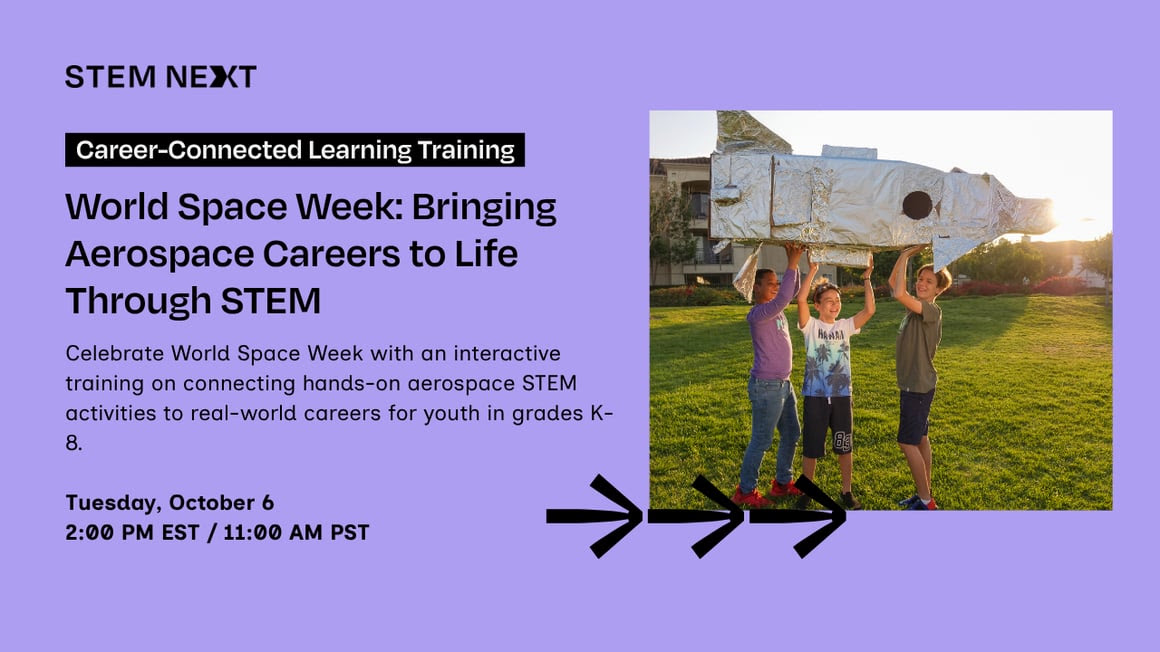 World Space Week: Bringing Aerospace Careers to Life Through STEM – Celebrate World Space Week by helping young people discover where an interest in aerospace STEM could take them. In this interactive training, afterschool and summer educators will explore how hands-on aerospace activities can introduce youth to real-world careers and help them understand the STEM knowledge and skills professionals use every day. Learn more here.
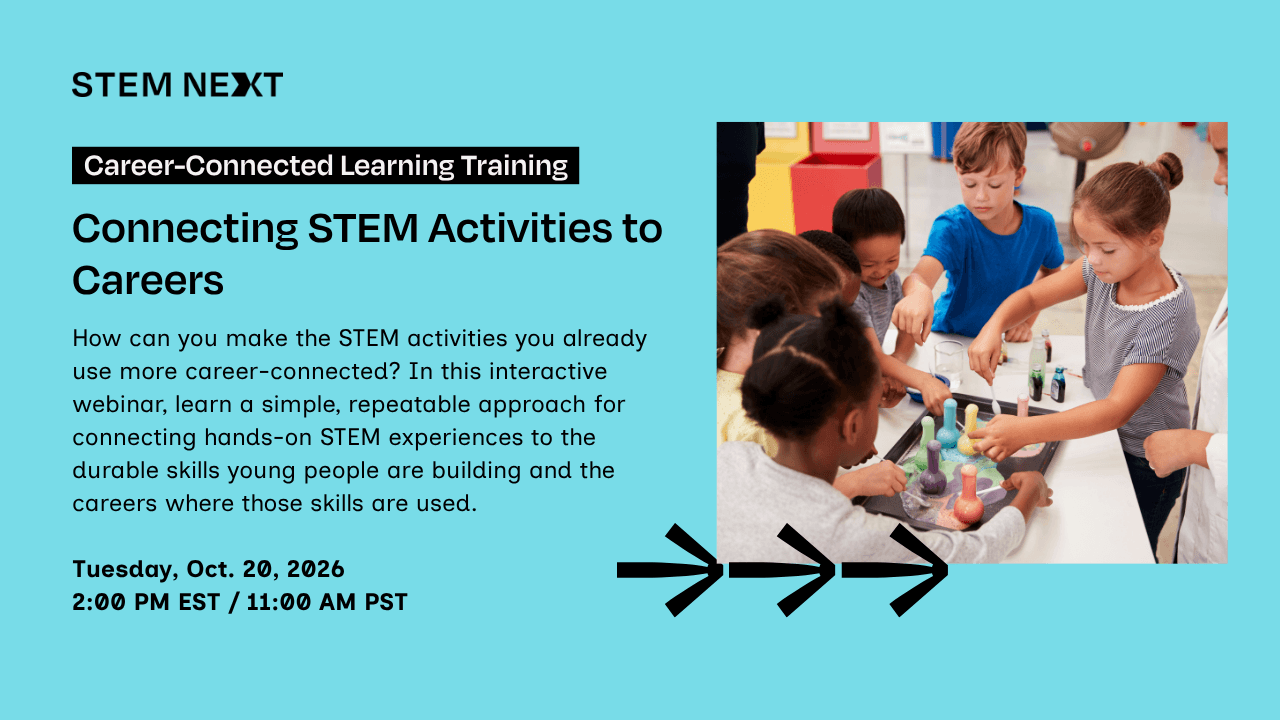
Connecting STEM Activities to Careers – How can you make the STEM activities you already use more career-connected? In this interactive webinar, learn a simple, repeatable approach for connecting hands-on STEM experiences to the durable skills young people are building and the careers where those skills are used.
Participants will explore practical strategies for embedding career exploration into STEM activities—from identifying relevant careers and workplace skills to designing experiences that help youth see the relevance of their learning and envision future possibilities. Learn more here.
How to Learn Math: For Students – How to Learn Math is a free self-paced class for learners of all levels of mathematics. It combines really important information on the brain and learning with new evidence on the best ways to approach and learn math effectively. Many people have had negative experiences with math, and end up disliking math or failing. This class will give learners of math the information they need to become powerful math learners, it will correct any misconceptions they have about what math is, and it will teach them about their own potential to succeed and the strategies needed to approach math effectively. If you have had past negative experiences with math this will help change your relationship to one that is positive and powerful. The course will feature videos of math in action – in dance, juggling, snowflakes, soccer and many other applications. It is designed with a pedagogy of active engagement. The course is planned to remain available indefinitely. Access English and Spanish versions here.
Launch into a New School Year with NASA – A new school year brings fresh opportunities to get involved with NASA. Whether you’re curious about space or eager to build durable skills for future employment, NASA offers a world of experiences putting you close to the action. As we enter a new golden age of exploration, there’s no better time to jump in, try something bold, and see where your curiosity takes you. This article gives a summary of how educators, families and youth can connect to NASA’s resources.
Youcubed at Home: Math Activities to be Done at Home – From Youcubed, this page shares different activities that have been designed to do with children at home.
- Counting All the Things (K-12) — In this activity, explore ways of counting large amounts of flowers, trees, birds, people, and more in spaces and places you go. While you’re out for a walk in the neighborhood or making a run to the grocery store, take a picture of a crowded flower patch or bread aisle and discuss ways of counting how many flowers or loaves of bread there are. Print the picture, annotate it using any image editing software available to you, or upload it to Geogebra to use the grid lines and their other tools. Think about different ways of counting and representing your thinking visually. If you want to explore algebra, ask yourself questions like, if my bedroom floor was covered in flowers like this flower patch, how many flowers would it take? Consider modeling your thinking about questions like this using algebra and generalizing it for any space.
- Reduce, Reuse Geometry (3-12) — Intersecting a 3D shape and a plane might seem intimidating, but a few bottles, a box cutter, and some creativity can give us some insight into what it can look like. A particularly interesting 3D shape to cut is the cone, as depending on how we cut, we can get circles, ellipses, and parabolas (hyperbolas too; those are harder to cut out). Thankfully, many bottles include cones, so we can have some fun cutting up bottles and using the conic sections we get to make art. Watch the video below for more details and some examples!
- Fraction Hunt (2-8) — Fractions are all around us! Walk around the house, yard and neighborhood with your child. Where do you see fractions? What would you call one part of the whole? For example, one rectangular stepping stone of 13 equally sized stepping stones would be 1/13th of the stepping stones. What if the objects are different sizes? Can they still be represented as a fraction? In the video, Kate represents one black key on the piano as one out of the total number of black keys. However, one white key can’t be represented as a fraction of all of the white keys since they are different sizes. Can you represent the object in more than one way? For example, ⅕ is equivalent to 2/10. Can you see this in the object?
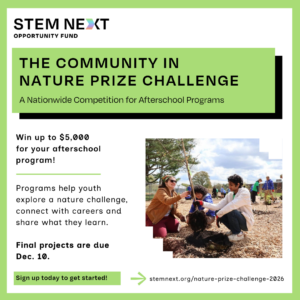
Community in Nature Prize Challenge – Enter STEM Next Opportunity Fund’s 2026 Community in Nature Prize Challenge to win up to $5,000 for your program! STEM Next Opportunity Fund has launched the 2026 Community in Nature Prize Challenge, inviting afterschool programs to design and complete activities that connect nature, community impact, and future careers. Youth teams will identify a nature-related issue or opportunity that matters to them, explore the careers connected to it, and share what they learned in a project artifact. All submissions are due by December 10, 2026. Learn more and sign up here.

World Space Week – Aeronautics & Aerospace Activity Bundles for Grades K-8 – Bring the science of flight and space exploration to life with hands-on activities designed for different grade levels and step-by-step guides to facilitate them with your youth. Each bundle includes four ready-to-use lessons that build STEM skills while introducing youth to related careers. Grades K – 2 Grades 3 – 5
 Earth Science Week – The 2026 Earth Science Week theme, “Critical Minerals for a Thriving Society,” highlights how critical minerals support essential needs and how the development of new technologies can affect which minerals are considered critical and how geoscience knowledge is essential for identifying, mining, refining, transporting, and using them responsibly. Click here for additional resources, activities and contests.
- Quick Hands-on Earth Science Activities – Need a quick activity for earth science education? Click here for hands-on activities that can be done in 15-30 minutes that get students thinking about how things really work.
- Resources from the National Parks Service, plus National Fossil Day (October 14) info.
 National Chemistry Week
- Explore Science: Let’s Do Chemistry Kit – Activities and professional development resources designed to stimulate interest, sense of relevance, and feelings of self-efficacy about chemistry.
- 20+ Chemical Reactions to Try – Free chemistry lesson plans, experiments, and activities to teach and explore chemical reactions with K-12 students.
Aeronautics & Aerospace Career Profiles
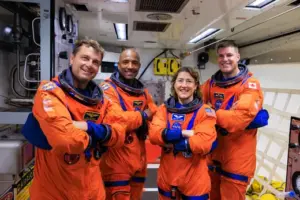
Explore five STEM careers that help make modern aviation and aerospace possible. Each profile introduces a different profession, explains how it contributes to the industry, and highlights the skills, education, and day-to-day responsibilities involved. View the Career Profiles
Launching Futures: A Toolkit for Afterschool Programs
The Launching Futures Toolkit, powered by RTX, was created specifically for afterschool and summer programs. This free resource makes it easy for educators to bring aerospace careers to life. This toolkit gives you access to a rich database of career-connected resources.
Research-Based Practices & Career Awareness and Exploration
STEM Next aims to raise awareness of research-based practices proven to increase the quality of STEM learning experiences for youth, and is committed to strengthening career awareness and exploration in out-of-school time so youth are prepared for whatever comes NEXT.
CareerXplorer from LabXchange at Harvard University unites education and industry in an interactive career exploration tool built for learners. CareerXplorer unites K–12 education, higher education, and STEMM industries in one streamlined career exploration tool that emphasizes career-connected learning through interactive content.
Fun and Interactive Ways to Teach Kids About Jobs and Career Exploration – Explore innovative ways to make learning and job exploration an exciting adventure for kids.


